Amps to kVA Doesn't Match Amps to kW: Which Number Your Generator Needs
Amps to kVA is volts times amps over 1,000, times 1.732 for three phase. Amps to kW also needs the power factor, which is why the two answers differ. How to use both numbers when you size a generator.
Amps to kVA is volts times amps, divided by 1,000. That's the whole formula for a single-phase circuit: 20 A at 240 V is 4.8 kVA, every time, for any load. Amps to kW needs one more number, the power factor, and that missing number is why two calculators gave you two different answers. Neither one is broken. They're measuring different things.
kVA is apparent power, the full load the wire and the alternator carry. kW is real power, the part that does work and shows up on your meter. A generator has to cover both.
The amps to kVA formula for single phase and three phase
There are three versions, and picking the wrong one is the usual mistake.
- Single phase: kVA = amps × volts / 1,000.
- Three phase, line-to-line voltage: kVA = amps × volts × 1.732 / 1,000. The 1.732 is the square root of 3.
- Three phase, line-to-neutral voltage: kVA = amps × volts × 3 / 1,000.
Take a 32 A three-phase supply on a European 400 V system. Line-to-line: 32 × 400 × 1.732 / 1,000 = 22.17 kVA. Line-to-neutral at 230 V: 32 × 230 × 3 / 1,000 = 22.08 kVA. Nearly the same, because 400 / 1.732 is really 230.9 V.
Now the two ways people get it wrong. Drop 400 V into the single-phase formula and you get 12.8 kVA. Use 1.732 with the 230 V figure and you get 12.75 kVA. Both are about 42% low, and a generator sized on either number will trip the first time everything runs at once.
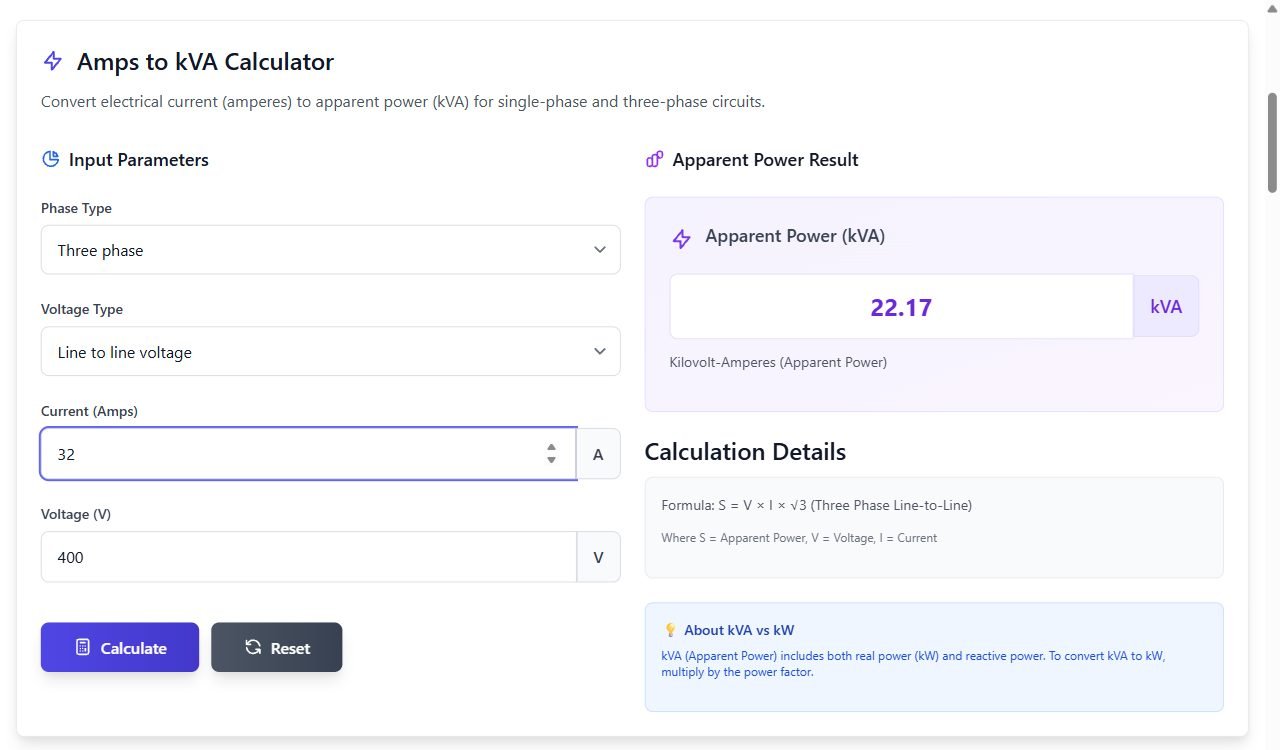
If you'd rather not do it by hand, the amps to kVA calculator has a phase dropdown and, for three phase, asks whether your voltage is line-to-line or line-to-neutral, which is exactly where the 1.732 versus 3 choice lives. It rounds to three decimals. It has no power factor box, and that's correct: kVA doesn't use one.
Why amps to kVA and amps to kW give different answers
Power factor is kW divided by kVA. On a purely resistive load like a kettle, a space heater or an old filament bulb, it sits at or very near 1.0, so kVA and kW come out the same. Motors are different. A pump or compressor pulls extra current to build magnetic fields that does no useful work, so the power factor drops below 1.
Say a well pump draws 10 A at 240 V. That's 2.4 kVA. At a power factor of 0.8 it only delivers 1.92 kW of real power. You're billed for the 1.92, but the cable and the generator's windings still carry the full 10 A. So kVA is what you size wiring and alternators on, and kW is what matches the engine and the bill. For that side, the amps to kW calculator takes the power factor as an input; if you don't know it, check the motor nameplate (often marked PF or cos φ).
Which number your generator needs
Standby and industrial generators are usually sold in kVA with a kW figure next to it, and the two are tied together by an assumed power factor of 0.8 lagging. A 100 kVA set is an 80 kW set. A technical note from Toromont, a Caterpillar dealer, works through a 480 V, 900 A three-phase unit: 480 × 900 × 1.732 / 1,000 gives about 750 kVA, and at 0.8 that's 600 kW. The same note explains the part most buyers miss. Above 0.8 power factor, the output is capped by the engine's horsepower. Below 0.8, it's capped by how many amps the alternator can carry. You can read it in Toromont's note on generator power factor.
So sizing goes like this:
- Add up the running kW of everything you'll power at the same time. That total has to sit under the generator's kW rating.
- Convert the running amps to kVA with the right formula above and add those up. That total has to sit under the kVA rating.
- Look at motor starting. A motor pulls several times its running current for a second or two when it starts, and that surge is almost all kVA. One big compressor kicking on can need more kVA than the whole running load.
A motor-heavy shop usually runs out of kVA first; a building full of heaters runs out of kW first.
Check these before you trust any amps to kVA result
Which voltage do you actually have? In the UK and most of Europe, 400 V three phase is line-to-line and 230 V is line-to-neutral. In North America it's 208 V line-to-line with 120 V to neutral, or 480 V with 277 V. If a spec sheet just says "230/400 V", the bigger number is line-to-line.
Where did the amps come from? Nameplate amps are the rated full-load current; a clamp meter shows what's flowing right now. Size on the nameplate.
Are the three phases balanced? Both three-phase formulas assume the same current on every leg. If one phase reads 32 A and another 18 A, size on the heaviest leg: 32 × 230 × 3 / 1,000 = 22.08 kVA. Adding the legs gives the true total, but the generator trips on the worst one.
My rule: size the generator on the kVA you worked out from amps, then confirm the kW fits. Whichever runs out first decides the size.