Claude Watermark in Your Text? It Isn't the Hidden Characters
Newer Claude models do watermark their text, but in the word choices, with no hidden characters added. Here's what a checker can find, what it can't, and what a clean result really tells you.
Yes, Claude watermarks its text now. No, you won't find that watermark by hunting for invisible characters. It lives in which words get picked, so a text file holding a watermarked answer can be byte-for-byte ordinary. Plenty of the "Claude watermark remover" pages out there are scanning for something Anthropic says isn't in the text at all.
How the Claude watermark actually works
Anthropic's post on its text watermark, published in August 2026, is blunt about the part people get wrong: "Nothing is added to the text and there are no hidden characters." No extra tokens either, so nothing changes on your bill.
What changes is the randomness. A language model usually has several reasonable next words and picks among them at random. The watermark, a version of Google DeepMind's SynthID-Text, swaps that random source for one steered by a secret key. Any single word looks normal. Over a long enough passage the pattern of picks can be scored against the key, and that's the whole signal.
A few details matter if you're trying to work out whether your text is affected:
- It applies worldwide to models launched since August 2, 2026. Older models are being added over the coming months, so an old answer may carry nothing.
- Short passages are weak. So are dry factual ones, where few wordings are acceptable.
- Code gets less of it where a term has to be exact, but comments can still carry it.
- Files are handled differently. PNG, JPG and SVG output gets a C2PA credential in the metadata instead.
What a Claude watermark checker can and can't see
Here's the awkward bit for anyone who built one of these, and we did. Our Claude watermark checker reads code points in your browser. It looks for zero-width characters, directional marks, tag characters, 16 kinds of odd space, curly quotes and dashes, plus class names like font-claude-message in rich text pasted from the claude.ai page. It cannot see the statistical watermark, and the tool page says so in a blue box under the results.
Run its built-in sample and you get a page full of findings:
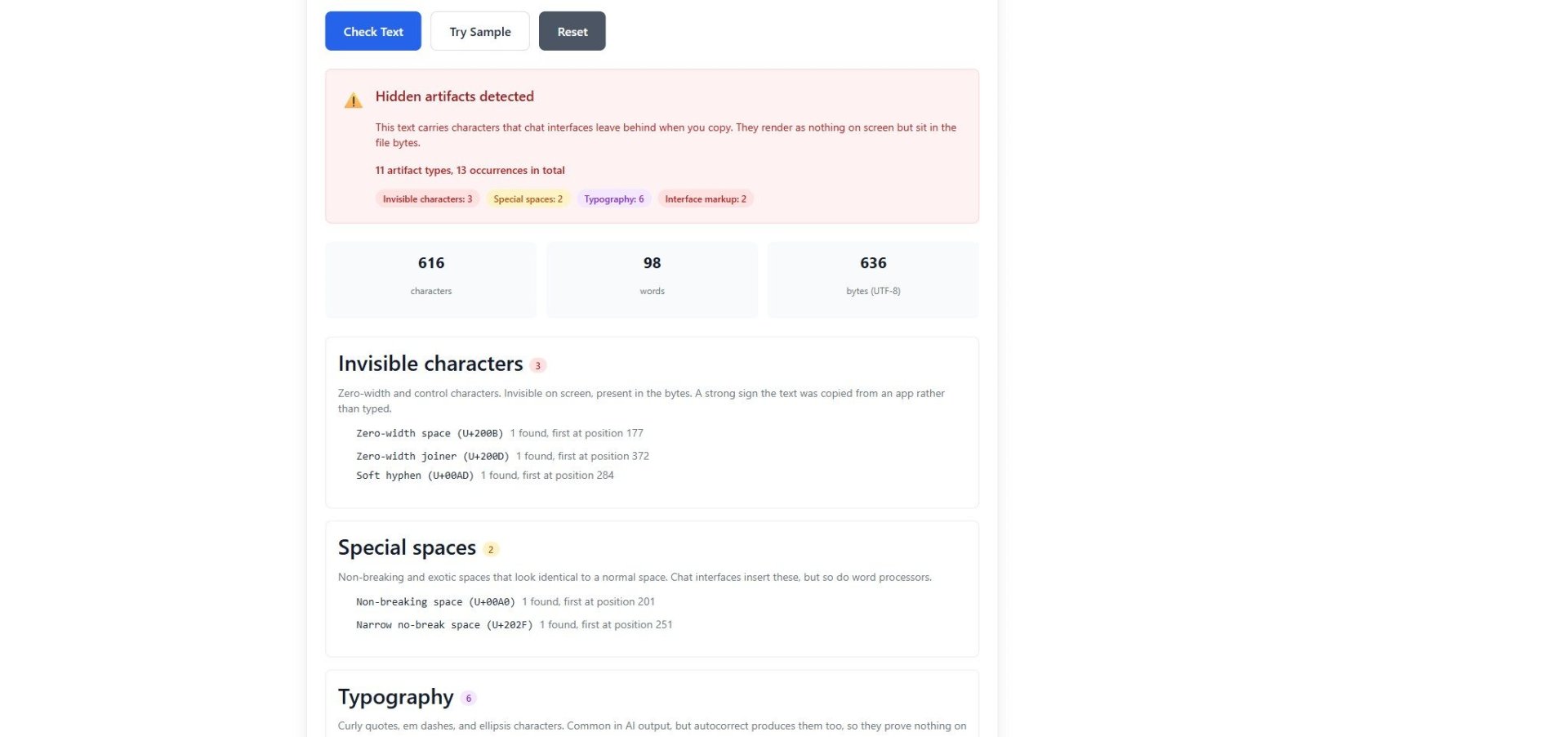
Those findings are real, and they can break real things. A zero-width space inside a variable name usually won't compile. A non-breaking space can stop a spreadsheet from reading "12 %" as a number. But they say where the text has been, not who wrote it. Word's AutoCorrect makes the same curly quotes, and PDFs and web pages leak the same spaces, though those alone only earn the amber verdict. One soft hyphen or zero-width space from a web page turns it red, on a document no model ever touched.
Now the opposite case, a plain status update in straight ASCII:
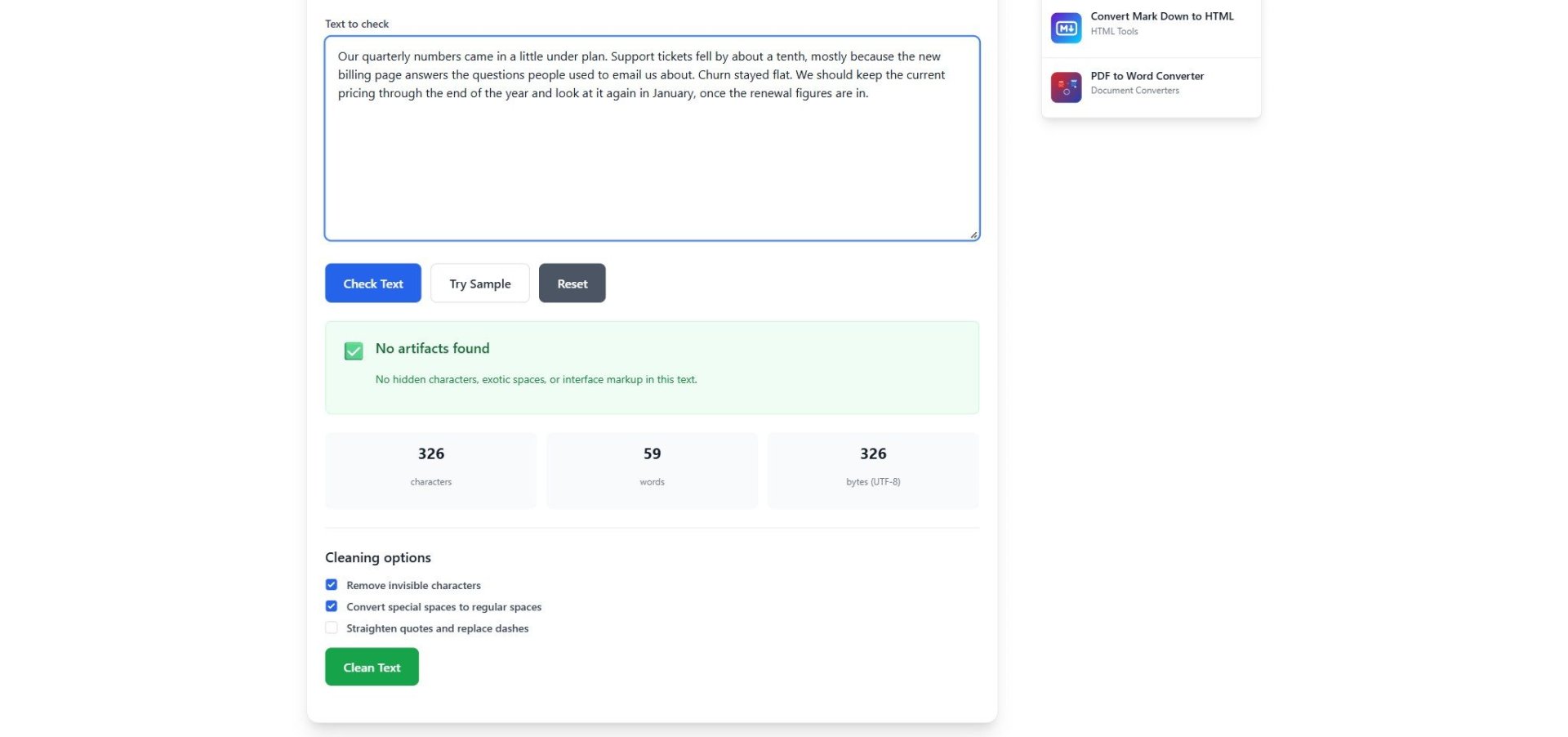
Green, nothing found. Paste a watermarked Claude answer that happens to contain only ordinary characters and you'd get this same green box, because the mark isn't a character. So read "No artifacts found" literally. It's a statement about bytes.
Can you remove the Claude watermark?
Not with a character cleaner. Our Clean Text button strips invisible characters and turns special spaces into normal ones, and there's an optional checkbox for straightening quotes and dashes. The words stay put, so the word-choice pattern stays too. Any tool promising to erase the Claude watermark by cleaning Unicode is fixing a different problem, whatever its headline says. Ours has "Remover" in its name too, and the only thing it removes is characters.
Anthropic's own description is that light editing probably won't remove it, and a complete rewrite replacing every word will. Its help center adds that heavy editing, paraphrasing, translation or mixing with other writing can weaken or remove the signal. A translation Claude itself produces still carries one, Anthropic says.
Cleaning is still worth doing when the text is going into code, a CSV or a CMS. That's the honest use for it. If you're worried about being found out, cleaning won't help, and I'd rather you heard that here than after paying for a "remover." The better move is telling whoever needs to know that you used it.
One small trap: Clean Text doesn't touch markup. If interface HTML ended up in your plain text as literal characters, delete it by hand. And if the warning came from the rich text side of your clipboard, paste as plain text next time.
What a result can prove
Less than people hope, in both directions.
You almost certainly can't get the watermark checked right now. Detection runs through an API in private preview for eligible groups such as regulators, media, researchers and educational organizations. Anthropic's public file checker reads image, video and audio credentials and says outright that it doesn't check text. So when a website reports a "Claude watermark score" for your essay, ask where it got the key.
Even a real detection is only a likelihood that Claude was involved. It can't separate text Claude wrote from text it heavily edited, and Anthropic says it carries nothing that traces back to a person, organization or chat. Missing marks prove nothing either, given old models, short passages and rewrites.
If you're a teacher or editor holding a suspicious document, neither our checker nor any public tool can settle it. Ask the writer about the work. That still beats every score on offer.