Title Case Rules: Which Small Words Stay Lowercase in AP, APA and Chicago
AP, APA and Chicago disagree on four-letter prepositions, yet, so, if and the last word of a title. Here's where each one draws the line.
"The Girl From Mars" and "The Girl from Mars" are both correct. So are "Something to Answer For" and "Something to Answer for." Which one you want depends on whose rulebook your editor, professor or client follows, and that's the whole reason two title case converters can give you two different answers for the same line.
Nearly all of the disagreement comes down to a handful of short words: four-letter prepositions, a few small conjunctions, and whatever word ends the title. Long nouns and verbs are never the problem. Here's where AP, APA and Chicago split, and where a quick converter lands.
Title case rules side by side: AP, APA and Chicago
"lower" means lowercase unless the word opens the title. The Chicago column follows the 18th edition, which changed the preposition rule (more on that below).
| Words | AP | APA | Chicago, 18th ed. | Our case converter |
|---|---|---|---|---|
| a, an, the | lower | lower | lower | lower |
| and, but, or, nor, for | lower | lower | lower | lower |
| yet, so (as conjunctions) | lower | lower | Capital | lower |
| if | lower | lower | Capital | Capital |
| with, from, into, over | Capital | Capital | lower | lower |
| upon, like, near | Capital | Capital | lower | Capital |
| about, under, between, through | Capital | Capital | Capital | Capital |
| Short last word ("Answer For") | Capital | lower if it's a short minor word | Capital | Capital |
Two rows do most of the damage. The four-letter prepositions split AP and APA from Chicago, and the last word splits APA from everyone else.
AP: the four-letter line
AP is the newsroom and PR standard, and its rule is pleasantly mechanical. Articles, prepositions and conjunctions of three letters or fewer stay lowercase. Anything with four letters or more gets a capital, whatever part of speech it is. The first and last words always get one too.
NC State University's editorial style page on composition titles, an AP-based house style, puts the line plainly: capitalize prepositions like above, after, down, inside, over and with, and conjunctions like because, while, since and though. Its own example shows both sides of the cutoff in one title: "Living With Both Feet off the Ground." "With" has four letters. "Off" has three.
That same page also shows why house styles drift. It capitalizes both parts of a phrasal verb ("Turn Off the Lights in Silence") and capitalizes "to" in an infinitive ("What I Want To Be When I Grow Up"). Both depend on what the word is doing in the sentence, so no spelling-based converter will get them right for you.
APA: same cutoff, different ending
APA uses the same four-letter line, so a psychology paper and a news story agree on "The Girl From Mars." Short words that count as major words still get capitals in both styles: "We Should All Be Feminists," "Marley and Me." Being short doesn't make a verb or pronoun minor.
The split shows up at the end. AP capitalizes the last word no matter what it is. APA capitalizes it only when it's a major word or has four or more letters. So AP gives you "Something to Answer For" and APA gives you "Something to Answer for." It looks like a typo to most readers, but it's what the APA rule produces.
Chicago changed its title case rules in the 18th edition
Through the 17th edition, Chicago said to lowercase prepositions regardless of length, with an exception for prepositions used as adverbs or adjectives. That rule produced titles like "Four Theories concerning the Gospel according to Matthew," which looks odd to most readers.
The 18th edition replaced it with a length test. University of California Press's summary of the 18th edition changes puts it in one line: prepositions of five letters or more, such as through, between and around, are now capitalized in titles and headings. One of Chicago's new examples is "Writing Under a Deadline and Without an Editor."
Notice where the line sits. Five letters, not four. So "with," "from," "into" and "over" stay lowercase in Chicago, and that's now the most visible gap between Chicago and AP. A few other Chicago habits catch people out:
- Only and, but, for, or and nor are treated as minor conjunctions. "Yet," "So" and "If" get capitals: "Even If We Break."
- "To" and "as" stay lowercase in any role, not just as prepositions.
- A preposition working as an adverb gets a capital, like "Up" in "Look Up" or "Down" in "Turn Down."
- "vs." stays lowercase, but the spelled-out "Versus" has six letters and gets a capital.
- After a prefix that can't stand alone, the second part stays lowercase: "The Anti-inflammatory Diet Cookbook."
If you're editing a book that started under the 17th edition, check which edition the house style sheet names before you "fix" anything.
What our case converter does with title case
The Title Case button in our case converter runs in your browser tab, and your text isn't sent anywhere. It works from one fixed list of small words: a, an, the, and, but, or, nor, for, so, yet, as, at, by, in, of, off, on, per, to, up, via, vs, v., from, into, onto, with and over. Those stay lowercase unless they're the first word of a line, the last word, or follow a word ending in a colon, full stop, question mark or exclamation mark. Every other word gets a capital.
That list is a blend. On the prepositions in its list it behaves like Chicago's 18th edition ("from" and "with" lowercase, "Under" and "Between" capitalized), but four-letter prepositions it doesn't list, like "upon" and "near", get capitals. On "yet" and "so" it behaves like AP and APA. Here are six test titles run through it:
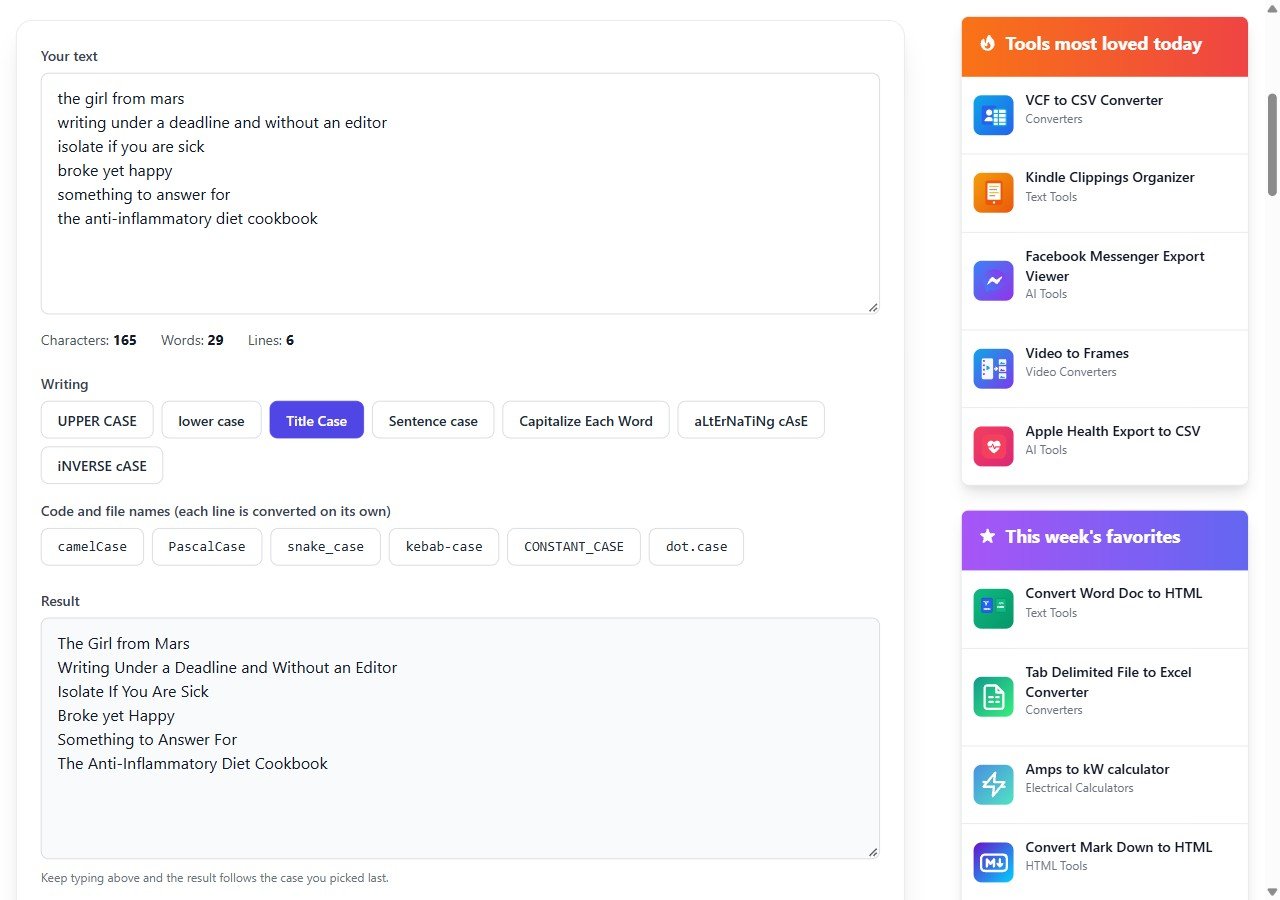
A few behaviors are worth knowing before you paste in a long list of headings:
- Each line is its own title. Paste 40 headings, one per line, and each comes back with its own first and last word capitalized.
- It can't read grammar. "Turn up the Heat in the Kitchen" keeps "up" lowercase, even though Chicago would capitalize it there.
- Four-letter prepositions not on the list get capitals. "Once Upon a Time Near the River" is right for AP and APA and wrong for Chicago, which wants "upon" and "near" lowercase.
- Every part of a hyphenated word gets a capital. You'll see "Anti-Inflammatory" and "Step-By-Step." Chicago would keep the "i" in "Anti-inflammatory" lowercase.
- Inner capitals survive, with one catch. "iPhone," "McDonald" and "NASA" are left alone as long as your text contains a lowercase letter somewhere. Paste a title that is entirely in capitals and that protection switches off: "IPHONE TIPS FOR NEW USERS" comes back as "Iphone Tips for New Users." Mix that same all-caps line in with normal lines and it comes back untouched, because every all-caps word looks like it has an inner capital.
None of that is unusual for a converter. The point is that "title case" on a button means somebody's rule list, and you should know which one before you trust it with a reference list or a table of contents.
Which title case rules should you follow?
Pick by where the text is going, not by which version looks nicer:
- News, press releases, company blogs: AP, unless your organization has its own style page. If it does, that page wins.
- Student papers and journal articles in the social sciences: APA. Watch the last word.
- Anything a publisher or editor says follows Chicago: confirm which edition. The Chicago Manual of Style Online sits behind a subscriber login, though there's a 30-day free trial if you only need to check a few rules.
- Your own site or slide deck: pick one and stay with it. Inconsistent headings look worse than either rule.
My honest advice: let a converter do the bulk of a long list, then scan the output for a short list of words. For AP or APA, that's "with," "from," "into," "over," "if" and, in APA, the last word. For Chicago, it's "yet," "so," "upon," "like" and "near." Fix those to match your guide and you've covered most of what a reader or grader will notice.