
Percentage Change Doesn't Match? Points vs Percent and the Wrong Base
A rate going from 3% to 5% rose 2 percentage points and also rose 66.7%. Why two people get different answers for the same percentage change, and how to check which one is right.
If a rate goes from 3% to 5%, it rose by 2 percentage points. It also rose by 66.7 percent. Both answers are correct. They measure different things, and that's usually why your percentage change and someone else's percentage change for the "same" move are miles apart. Points are the plain gap between two percentages. Percentage change is that gap divided by where you started.
When the numbers still don't line up after that, it's almost always one of two other slips: dividing by the wrong value, or adding up percentages that were applied one after the other. Each takes a few seconds to check.
Percentage points vs percentage change: which one have you got?
Subtract one percentage from another and you get percentage points. Divide that gap by the starting percentage and you get a percentage change. The ONS style guide on percentages and percentage points gives the cleanest example I know: 10% falling by 1 percentage point becomes 9%, but 10% falling by 1% becomes 9.9%.
So when a headline says a mortgage rate "rose 2%", ask which one they mean. Unemployment moving from 4% to 5% is a 1 point rise and a 25% rise. Neither is wrong. What bothers me is people picking whichever sounds bigger for their argument, and that happens a lot with poll numbers and interest rates.
A quick rule: if both numbers already have a % sign, say "points" for the difference. Save "percent" for the relative change.
The wrong-base mistake in a percentage change calculation
The formula is (new minus old) divided by old, times 100. The base is always the old value. A price moving from $80 to $100 is a $20 gap, and $20 out of $80 is 25%. Divide by the $100 instead and you get 20%, which is the answer to a different question: how far it would have to fall to get back to $80.
That asymmetry trips people up constantly. Same $20, 25% going up, 20% coming down. If a colleague gets 20 and you get 25, one of you put the new number on the bottom.
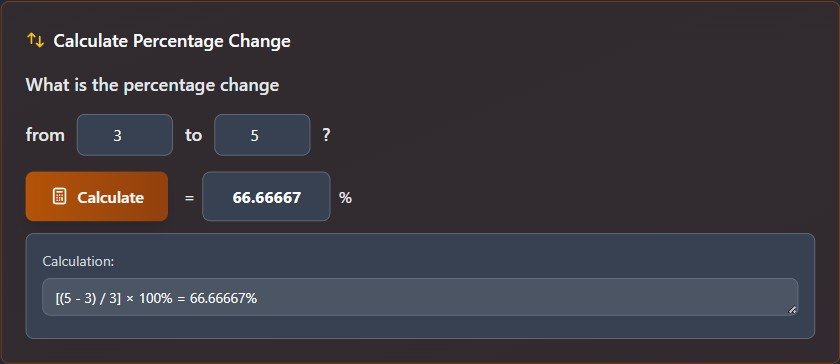
If you'd rather not do it by hand, the percentage change box in our percentage calculator always uses the "from" number as the base and prints the working underneath, so you can see exactly what got divided by what.
Two edge cases are worth knowing before you trust any calculator, ours included:
- Starting from zero. A change from 0 to anything has no percentage. You'd be dividing by zero, so the calculator refuses with an "Initial value cannot be zero" message. Report the raw change instead ("from 0 to 40 signups").
- Negative starting values. The standard formula divides by the signed old value. Going from -10 to -5 is an improvement, yet it comes out as -50%. Spreadsheets do the same thing with =(B1-A1)/A1. For profits and losses that cross zero, I'd skip the percentage and just state the two figures.
The result is rounded too. Three to five shows as 66.66667, which you'd normally write as 66.7%.
Why a 50% drop needs a 100% rise to recover
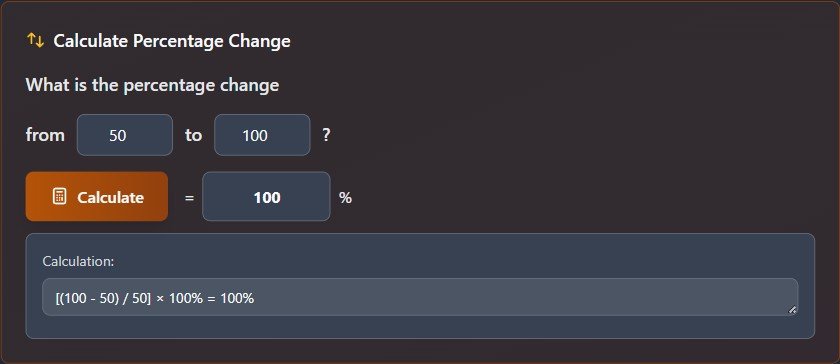
This is the wrong-base problem again, wearing a different coat. Something falls from 100 to 50, a 50% drop. To get back, it has to climb from 50 to 100. The base is now 50, so that climb is 100%.
The bigger the drop, the worse it gets. A 20% fall needs a 25% gain to break even. A 30% fall needs about 42.9%. A 75% fall needs 300%. If you want the general version, a drop of d (as a decimal) needs a rise of d divided by (1 minus d).
It also explains why "down 50%, then up 50%" doesn't put you back where you began. 100 drops to 50, then 50 grows by half to 75. Anyone tracking a portfolio, a website's traffic or a shop's monthly sales runs into this sooner or later.
Stacked discounts and compound growth don't add up
A coat is 20% off, and the checkout takes an extra 10% off the sale price. That isn't 30% off. It's 28%. The $100 coat drops to $80, and 10% of $80 is $8, so you pay $72.
The trick is to multiply what's left, not add what's taken: 0.8 times 0.9 is 0.72, so you're paying 72% of the original. A flat 30% off is the better deal every time, which is exactly why shops love the stacked version.
Growth works the same way in reverse. Two years of 10% growth is 1.1 times 1.1, which is 1.21, so 21% in total and not 20%. Over ten years the gap gets large: 10% a year compounds to roughly 159%, not 100%.
One thing that doesn't matter is the order. A 20% discount then 8% sales tax gives the same final price as tax first and discount second, because multiplying doesn't care about order. Adding is the part that goes wrong.
So when two numbers for the same change disagree, write three things down: the start value, the end value, and which one sat underneath the division. Most of the time that's the whole argument settled.